A Banner Month For Elephants?

Two breaking news items on the elephant conservation front over the last few days. First, Ringling announces the retirement of their elephants more than a year earlier than originally planned. Now, only 19 days into 2016, Hong Kong Chief Executive Leung Chun-ying announced plans to “phase out” ivory sales in the city. In a city where 400 sellers are allowed to trade ivory material and products despite the ban of importing and exporting ivory in Hong Kong, this comes as a welcome reprieve for elephants everywhere. However, this is a city where this black market item seems to flourish in sales, it could be difficult to get trade to stop all together.

While banning ivory may not seem like a complicated issue, it has a long history of being in demand around the world and it has not been easy to get the trade to diminish. Ivory is used in souvenirs, art, instruments, clothing, and traditional medicine in some cultures. Ivory is the teeth of elephant and mammoths but the term has also been applied to other large mammals whose teeth are of commercial trade interest (US Fish & Wildlife). In 2015, the US Government hosted an Ivory Crush in New York’s Times Square to demonstrate to ivory traffickers world-wide that the trade of ivory will not be tolerated by the United States. More than 100,000 elephants in three years were killed for their ivory and these numbers are not sustainable for the continuation of the species. To put that into further prospective, roughly 1 in 12 African Elephants were killed for their ivory in 2011 (National Geographic). Elephants have a gestation period of almost 2 years, spend the first 3-5 years with their mother, and then between the ages of 8-13 years elephants sexually mature. Adulthood for elephants, like humans, starts around the age of 18 and they have a lifespan of up to 70 years in the wild. Elephants are typically found in herds dominated by females; and adult males tend to be loners and only find females during the mating seasons. According to the IUCN, current African Elephant populations are increasing but only at a rate of 4% per year.

All elephant populations face the same conservation issues, but the Asian Elephants are listed as endangered whereas the African Elephants are currently listed as vulnerable. Elephants need more time than say a mouse species (which can have 5-10 litters of 4-6 young per year in some cases) to bounce back from poaching and hunting. The efforts of governments world-wide to ban the illegal trade of ivory is admirable, but governments need to continue enforce their laws and regulations in order to help save these species from disappearing from Earth’s landscapes. So, is it a banner month for elephants? Perhaps, but more work needs to be done – just like with many other species and landscapes facing extinction.


Elephant Life Cycle

US Fish & Wildlife Ivory Ban Questions & Answers
History of the Ivory Trade (NatGeo)

Stop the Ivory Trade

Fantastic Friday: Mating Rituals

Kick off your weekend learning about the diverse mating rituals of different species across Earth – both past & present. Click on the source (i.e., National Geographic) for the full article. 

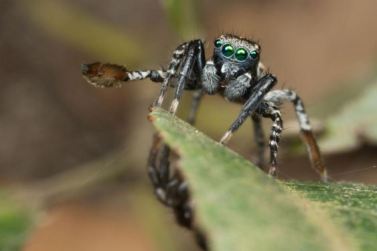
A new spider species in Australia uses paddles to attract mates

“In a bizarre ritual, an amorous male hides on the underside of a leaf and thrusts the paddle high enough for a female on the other side of the leaf to see it. The researchers know of no other jumping spider that conducts such a peekaboo courtship—nor of one that has built-in paddles on its legs, according to a study published January 7 in the journal Peckhamia.” – National Geographic 1/15/2016

spider paddle
J. remus waves his paddle hoping to attract a lady. Source: National Geographic & Photo Credit: Jurgen Otto

Where dinosaur head ornaments used for sexual selection?

“Another paper in 2012 notes that it may have been the case that, for many dinosaur species, both males and females had prominent features, and both sexes preferred mates with the most elaborate structures.” – IFLS 1/14/2016

Clash of the Titans & Other Animal Mating Rituals

“One of the most fearsome of such battles occurs every spring among bull elephant seals. The Sumo wrestlers of the animal world, male elephant seals are quivering masses of blubber weighing up to 6,600 pounds. When they go at each other, a pair of bulls rear up, roar loud enough to make the earth shake, and collide with a thunderous crash. The whites of their bulbous eyes showing, they gnash at each other’s fleshy necks with blunt teeth that leave grievous-looking wounds and nearby beach water stained crimson with blood. It’s a dangerous game, but the payoff is enormous.” – PBS 12/1/2001

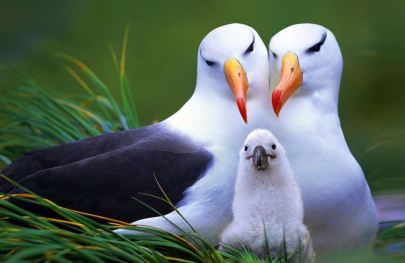
Albatross Romance & Mating Ritual

As narrated by David Attenborough: YouTube 2/12/2007

albatross
Albatross species with nestling. Source: Alphacoders

What Do Dinosaurs Find Irresistable? Sexual Dimorphism in Dinosaurs

“Non-avian dinosaurs were weird. That’s one of the reasons we love them so much. There’s nothing quite like a slender-necked Barosaurus, a beautifully-crested Dilophosaurus or lavishly-ornamented Pentaceratops alive today. If such dinosaurs were anything, they were bizarre, but why were they so strange? Each case demands its own explanation, and paleontologists have continuously tussled over whether particular ornaments were weapons, sexual displays or something else.” – Smithsonian 9/7/2012


The Ethics of Birding


DSC_0966
Cattle Egrets foraging in Belize, November 2015, photo by Heather Kostick

What an important topic for the millions of humans that like to bird watch. I have been birding probably most of my life without realizing it as my mom has always been a “backyard birder”. My mom has this elaborate bird feeder with six compartments that you could fill with multiple kinds of seeds, and it slides up and down on a metal pole that makes it incredibly difficult for squirrels to climb. I started to take birding more seriously when I took an ornithology course at my alma mater Juniata College in 2010. The course took place over the summer at the Raystown Field Station which serves as an excellent place to get some field experience. One of the first things my professor, Dr. Chuck Yohn, talked about was the ethics of birding. There’s a laundry list of things you shouldn’t do while birding, but people do them anyway. I strive to not demonstrate bad birding behavior as an example to others and to leave as little impact on the birds and ecosystem as possible. Here’s a short list of things to avoid and some articles at the bottom for best practices.

  • The welfare of the bird is the biggest priority. Do not endanger the bird by getting too close, taking pictures of nestlings (you’re leaving a trail and a clue to predators), or staying too long. Birds think that you are a predator and will expend energy avoiding you. Remember, this is a hobby for you and survival for them. Some birds are simply too exhausted to move (see Snowy Owls) and may seem calm but in reality just don’t have the energy to avoid you. Be respectful and remember that birds need space.
  • Keep yourself safe. Take your time. It’s generally not worth breaking a limb trying to get that bird or perfect photo.
  • Respect the land. Make sure you are allowed to be where you are. Are you birding on private or public land? (Better find out.) Private landowners are not always so keen on birders appearing no matter how rare the sighting is (See this article – there is no definitive proof who shot the bird).

Birding Ethics as Outlined by Other Resources

Find your local birding club for more resources and to learn more about birding.


Offshore Drilling: A Conundrum


offshore-oil-rig pretty
Offshore Oil Rig, Source: offshore-job.net

It is hard to say whether or not we should continue to allow and promote offshore drilling, because it’s a complicated issue. On one hand, our renewable energy technology isn’t where we need it to be for that source of energy to be our primary source; and updates to the power grid would have to happen in order to deal with renewable energy. On the other hand, these offshore oil rigs can have a negative impact on the environment and wildlife, and extracting oil promotes the use of a source of fuel that will eventually run out. I think it would be wise to not allow any more offshore rigs to be built, divest in oil, and start to reinvest money that would have been used for oil into renewable energy.

examples-offshore-drilling
Examples of Offshore Oil Rigs, Source: UAF

Offshore oil rigs come in a variety of structures, but the riskier ones are the floating production system. They are dangerous not only because of the potential for oil leaks during transportation, but also because of hurricanes. From about August through November, hurricanes go through the Gulf of Mexico. While oil rig companies make preparations for hurricanes, they cannot necessarily hurricane-proof offshore rigs; rigs can be damaged and leak oil as a result of hurricanes. The wildlife and environment are used to natural slow leaks of oil from the Earth’s crust, but are unable to handle a large amount in one time event. The BP oil spill in 2010, not caused by a hurricane, is an example of how wildlife and the environment are affected by a massive oil spill. This 2010 oil spill produced wildlife casualties, but luckily when a spill occurs, there are crews ready to deal with the clean up of both wildlife and the environment. Tri-State Bird Rescue was the lead responder on the BP 2010 oil spill, and while data is not yet available due to legal issues, it’s safe to say that without these oil spill responders, the devastation on wildlife could have been greater.

If we divest in oil and reinvest money into renewable energy, part of that investment could be made into the power grid. The power grid needs updating if we are to start relying more heavily on renewable energy. Along with not building anymore offshore oil rigs, there is the issue of abandoned oil rigs and not knowing exactly what sort of impact they will have on the environment. There are already 27,000 abandoned oil rigs and wells in the Gulf of Mexico, with some dating back to the 1940s, that need to be dealt with. These rigs were built with materials that may not be suitable to withstand a long-term marine environment, and they can (and do according to this news article) leak. That’s more oil and materials going into the ocean that is already taking a huge hit from anthropogenic pollution. As a species, we need to take responsibility for the impact we have on the environment and lessen it whenever possible.

Sources:

http://ffden-2.phys.uaf.edu/212_spring2011.web.dir/kristine_odom/temp/10956/ftddrops/Upstream.html

https://tristatebird.org/effects-on-wildlife/

http://www.cbsnews.com/news/gulf-oil-spill-whos-to-blame-bp-halliburton-and-the-feds-are-all-implicated/

http://www.epa.gov/osweroe1/docs/oil/edu/oilspill_book/chap7.pdf

http://www.pserc.wisc.edu/research/project_summaries/S-52.aspx

http://www.news.cornell.edu/stories/2015/03/adding-renewable-energy-power-grid-requires-flexibility

http://www.nola.com/news/gulf-oil-spill/index.ssf/2010/07/27000_abandoned_oil_and_gas_we.html